Laundry Strip Packaging Automation: Why China's Fastest-Growing Detergent Segment Is Hitting the Manual Labor Wall
China's laundry detergent sheet market is exploding — but for many manufacturers, that growth is quietly eroding the very margins it should be building. Here is the data behind the problem, and the economics of the solution.
The numbers are unambiguous. China's laundry detergent sheet market is growing at a compound annual rate of 14.16%, according to Deep Market Insights — and IndexBox's independent analysis places the retail volume expansion rate even higher, at 18–25% annually from 2026 to 2030. By 2033, the market is projected to more than triple its current size.
This is not incremental growth. It is the kind of demand curve that forces operational decisions: expand capacity, add shifts, bring in more hands. And that is precisely where the problem begins.
Because while order volumes are climbing at double digits, the cost of the labor required to package those orders is climbing too — and it is doing so at a rate that most manufacturers did not model accurately when they decided to scale.
According to Trading Economics data sourced from China's National Bureau of Statistics, the average annual wage in Chinese manufacturing rose by 5.2% year-on-year from 2024 to 2025 — and that figure understates the real cost to employers: social insurance contributions, housing fund obligations, overtime premiums during peak demand, and recruitment costs for positions with high turnover typically push the effective labor cost 35–50% above the headline wage figure.
For laundry strip manufacturers specifically, the packaging stage — the open-box, fill, seal, and stack sequence at the end of every production run — is where labor cost pressure concentrates most acutely. And it is the one stage where automation delivers the most immediate, measurable return.
The operational pattern repeats across China's laundry care manufacturing sector: a factory receives growing orders, expands its production floor, and hires additional packaging workers to handle the increased volume. Revenue rises. Output rises. But when the finance team runs the P&L two or three months later, the monthly profit figure is nearly unchanged — and in some cases, slightly lower than before the expansion.
This is not an anomaly. It is a structural feature of manual packaging at scale, and it manifests through five well-documented mechanisms:
Each new packaging hire adds throughput — but not linearly. Coordination overhead, training periods, supervision requirements, and quality variability all increase with headcount. A team of ten manual cartoning workers does not produce ten times the output of a single experienced worker. The real multiplier is closer to six or seven.
Manual laundry strip cartoning — erecting the carton, counting and inserting strips, folding and sealing flaps — is repetitive but precision-sensitive. Under time pressure, sealing integrity drops, count errors rise, and rework rates increase. A single batch rejection due to inconsistent counts or damaged seals can wipe out the margin from an entire production run.
A packaging line staffed by ten workers is one unplanned absence away from a throughput shortfall. In China's manufacturing sector, where average annual turnover rates in labor-intensive packaging roles can exceed 30%, the disruption is not occasional — it is routine. Each replacement requires retraining, and each retraining period represents a dip in output.
Ten workers at packing tables occupy substantially more floor space than a single automated cartoning machine running equivalent or higher throughput. In Chinese industrial zones where lease rates continue to climb — particularly in Guangdong, Zhejiang, and Jiangsu, where the majority of personal care manufacturers are concentrated — the floor space premium matters.
The math is unforgiving. If a factory adds eight packaging workers, the combined labor cost — wages plus mandatory employer-side obligations — adds a recurring annual burden that compounds as wages continue to rise. Manufacturing wages in China have increased every year for the past two decades without exception.
The conclusion is direct: manual packaging labor scales with volume, but not efficiently. At a certain throughput level, every additional worker becomes a cost center rather than a capacity solution.

China's packaging automation market tells the story of where the industry is moving. According to Fortune Business Insights, the Asia-Pacific region commands a dominant 31.81% share of the global packaging automation market, with China as the single largest contributor in the region.
Intelligent packaging equipment penetration in China reached 38.7% in 2023, according to industry analysis, and is expected to exceed 45% in 2025 and 65% by 2030. The direction is clear: the industry is systematically moving away from manual packaging at scale.
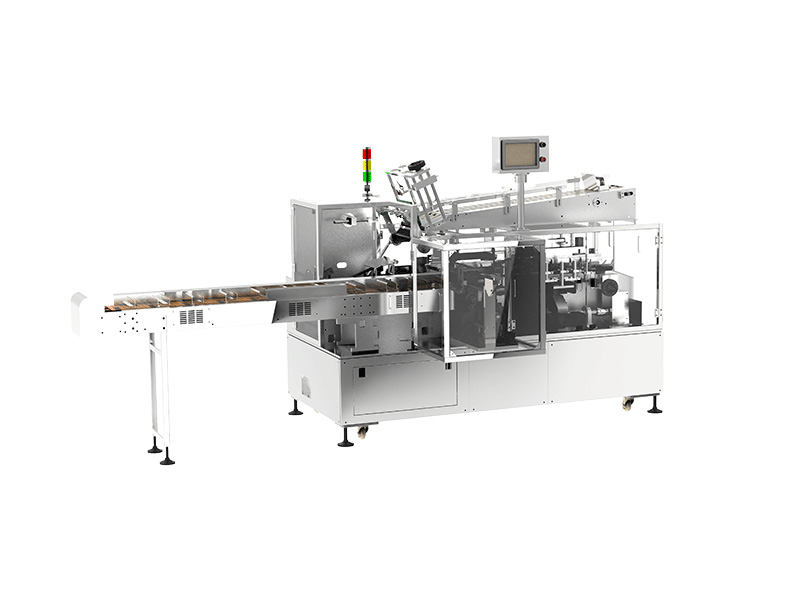
For laundry strip manufacturers, the specific automation solution is a cartoning machine that handles three sequential functions automatically:
Automatic box erection — flat carton blanks are fed from a magazine, erected, and positioned for loading without manual handling.
Automatic product loading — laundry strips are fed and inserted into the open carton in the correct count and orientation.
Automatic sealing — carton flaps are closed and sealed (tuck-end or hot-melt adhesive, depending on carton specification), and the finished carton exits the line ready for secondary packaging.
Three functions. One machine. One or two operators for monitoring and magazine replenishment. The workers previously standing at tables erecting boxes, inserting strips, and folding flaps by hand are no longer needed for that task.
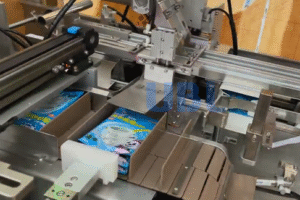
The economic case for automated cartoning in laundry strip production is built on three variables: labor replacement, throughput increase, and machine lifespan. Based on operational data from Huanlian's installed base across Chinese personal care manufacturers:
| Metric | Manual Operation | Automated Operation |
|---|---|---|
| Back-end packaging staff | 10+ workers | 2 operators |
| Staff reduction | — | ~40% of total packaging headcount |
| Packaging output | Baseline | +30% increase |
| Monthly labor saving | — | Eliminates ~8 workers' worth of labor cost |
| Machine investment | — | One-time capital outlay |
| Estimated payback | — | 4–5 months at stable order volume |
After the payback period, the monthly labor savings become direct margin. A cartoning machine with a useful operational life of 6–8 years under normal conditions — and 10 years or more with proper preventive maintenance — continues generating those savings long after the initial investment has been recovered.
To illustrate: the machine replaces eight workers' worth of recurring labor cost with a one-time capital investment that is recovered within the first five months. Over an 8-year operational life, the cumulative labor savings represent a return multiple exceeding 8:1 against the original machine cost.
The decision to automate packaging is not about factory size or revenue — it is about the point at which manual labor stops being the solution and becomes the cost. The specific trigger point varies: some operations hit it at 3,000 cartons per day, others at 10,000. But the indicators are consistent:
You have hired additional packaging workers in the past 12 months, but profit has not grown proportionally. If headcount has increased but margins have stayed flat or declined, the packaging labor cost curve is already eating your growth.
Your packaging team is the consistent bottleneck on the production floor. If upstream production runs faster than the packing line can clear, you are paying for manufacturing capacity you cannot fully utilize.
You are losing orders or declining volume because you cannot commit to delivery timelines. This is the most expensive symptom — it means your constraint is already costing you revenue, not just margin.
Quality complaints about packaging — loose seals, inconsistent counts, damaged cartons — are increasing. Manual packaging quality degrades under speed pressure; the rework and rejection costs are often invisible until they surface in customer complaints.
You are pricing quotes based on current labor cost but know that labor cost will rise if you accept the order. This is the clearest signal: if accepting more volume requires hiring more workers at rising wages, the margin on the additional volume is already committed to labor before it is earned.

Huanlian's approach begins with proof, not proposals. Send your laundry strip product and carton specifications, and Huanlian will run a live test on the cartoning machine and provide video documentation of the actual output — speed, seal quality, carton integrity — before any purchase decision is made.
For operations with non-standard requirements, Huanlian provides two layout options for your production floor, including equipment placement, footprint dimensions, and integration points with your existing upstream line.
Standard configurations ship within 5–7 business days after contract signing. Custom configurations — including non-standard carton dimensions, special seal requirements, or integration with upstream production equipment — typically deliver within 3 months.
For laundry strip and laundry sheet manufacturers currently running manual cartoning at mid-to-high volume — or planning a production expansion — the relevant calculation is not what the machine costs. It is what the machine saves, month after month, for the next decade.
With China's laundry detergent sheet market projected to more than triple by 2033 and manufacturing wages continuing their structural upward trajectory, the gap between manual and automated packaging costs will only widen. The manufacturers who automate at the right point in that curve will capture the margin that growth is supposed to deliver. Those who do not will continue expanding into lower margins and higher risk.

 Guangdong Huanlian intelligent Packaging Group Co., LTD
 86-15915757872
 86-13602308576
 sales@huanlianauto.com
 No. 7, Silver Lake Road, Sangyuan Industrial Zone, Dongcheng District, Dongguan City
 Back to top


 86-15915757872