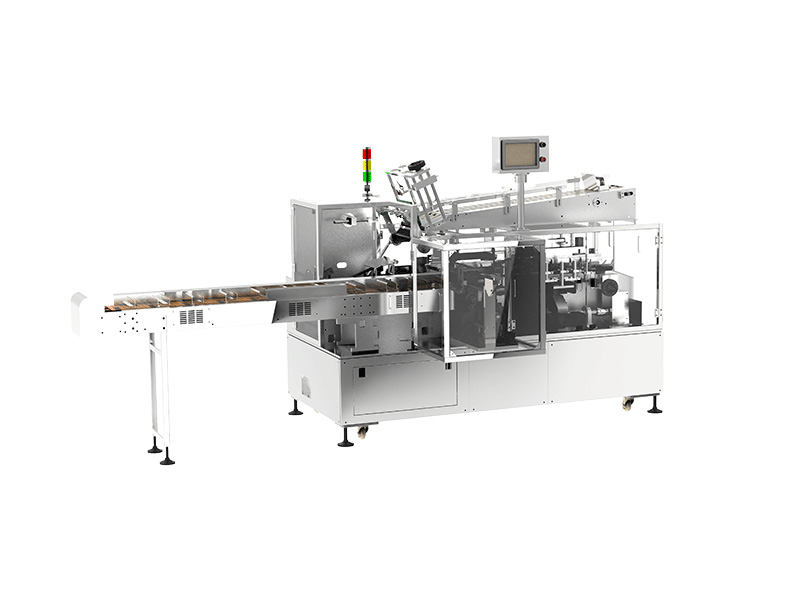
Detergent Sheet Box Packaging: The Operational Case for Automated Cartoning Systems
For a detergent sheet manufacturer, the production floor typically tells a divided story. The front of the line — formulation blending, film casting, cutting, and sheet stacking — hums at predictable, scalable throughput. Walk to the back of the line, and the picture often shifts: carton erecting tables, packing crews rotating through repetitive motions, stacks of flat boxes waiting to be formed, and a supervisor tracking output against an order deadline that tightens with every shift.
This disconnect between front-end capacity and back-end packaging throughput is not a temporary bottleneck. It is a structural cost center that compounds as order volumes climb. And for the growing number of detergent sheet manufacturers supplying export markets, retail chains, and e-commerce platforms, the gap between what the production line can make and what the packaging station can finish represents margin erosion that no amount of overtime can close.
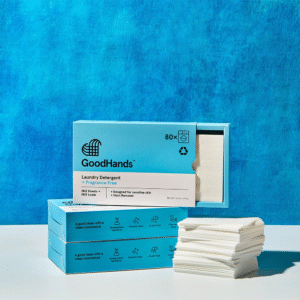
Most cost analysis in detergent sheet manufacturing focuses on raw materials — the PVA or PVOH film base, the surfactant blend, the fragrance load. Raw material optimization matters. But per-unit raw material costs tend to be stable and, in many cases, decline marginally as purchasing volumes increase.
The packaging station behaves differently.
Manual cartoning costs do not decline with volume. They scale proportionally — and in practice, they often scale faster than output. The reason is straightforward: a person forming, filling, and closing cartons operates within a narrow throughput band that degrades with repetition, shift length, and workforce churn. Adding throughput means adding headcount, which adds floor space, supervision layers, training cycles, and the hard-to-quantify cost of variability — a miscount here, a misaligned tuck there, a carton damaged during handling.
For a facility running 8,000 to 15,000 cartons per day on a manual packing line, the cumulative effect of these small losses is substantial. Industry estimates suggest that manual packaging operations in fast-moving consumer goods sectors typically operate at 85–92% first-pass yield, with rework absorbing 5–12% of total packaging labor hours. At export-grade volumes, even a 3% quality rejection rate translates to thousands of reworked or scrapped cartons per month — and the labor cost to produce those rejected units was already paid.
| Cost Category | How It Compounds | Automated Response |
|---|---|---|
| Direct labor overhead | Each incremental 1,000 cartons/day requires proportional headcount increase; wages, benefits, and shift premiums scale linearly | Throughput increase requires no additional operators — 1–2 personnel manage the line regardless of speed setting |
| Quality variability | Misalignment, miscounts, and inconsistent closure degrade at fatigue points; export buyers impose chargebacks for package defects | Identical cycle on every carton; mechanical precision eliminates operator-dependent variance |
| Opportunity cost of the throughput ceiling | A manual line maxes out at roughly 8–12 cartons per person per minute; expanding beyond that requires physical reconfiguration of the packing area | A single cartoning system operates at 30–120 cartons per minute; the ceiling moves from human fatigue to machine duty cycle |
The first two cost multipliers show up on a P&L statement. The third — the opportunity cost of being unable to accept a larger order because the packaging line cannot deliver on time — never appears in any ledger. It lives in lost contracts, buyer relationships that never started, and market share that went to a competitor whose packaging line scaled faster.
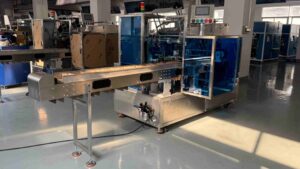
Framing a cartoning system purely as a machinery purchase misrepresents its financial role in the operation. A properly specified automated cartoning system functions as a margin protection mechanism that addresses all three cost multipliers simultaneously.
Here is what the machine actually executes in a typical detergent sheet application:
Carton forming from flat blanks. A vacuum-assisted magazine feed picks flat carton blanks, erects them, and positions them on the transport chain — without the repetitive manual folding that dominates a manual packing station's labor allocation.
Sheet stack insertion. Stacked detergent sheets are fed into the machine's product infeed. A push-feed mechanism — or in configurations requiring gentler handling, a pick-and-place system — transfers the exact stack count into the waiting carton. Count accuracy is mechanical, not visual. There is no "was that 24 or 25 sheets?" moment.
Carton closure. Depending on the carton specification, the system executes a tuck-end fold, a snap-lock bottom engagement, or a hot-melt glue bead application with consistent placement on every unit.
Output consistency. The first carton of the production run matches the last. Fatigue, shift changes, seasonal labor turnover — none of these variables touch the output quality of a cartoning system.
| Performance Metric | Manual Cartoning Line | Automated Cartoning System |
|---|---|---|
| Cartons per minute | 8–12 per packer | 30–120 (configuration-dependent) |
| Operators required (mid-volume) | 6–10 workers | 1–2 operators |
| First-pass yield | 85–92% (industry benchmark) | >99% |
| Quality variance source | Operator skill, fatigue, turnover | Mechanical precision |
| Scalability ceiling | Physical — more output requires more people, more tables, more floor | Machine duty cycle — speed settings within rated range |
The detergent sheet category is still early in its retail lifecycle, and packaging formats remain fluid. A brand launching in North American mass retail may require a tuck-end carton with a viewing window. A private-label contract for a European grocery chain may specify a snap-lock bottom for structural rigidity during transit. An e-commerce-focused direct-to-consumer brand shipping individual units may prefer a glue-sealed carton for tamper evidence.
A capable high-speed cartoning system accommodates all three formats without requiring separate packaging lines:
A manufacturer running multiple detergent sheet SKUs — different sheet counts, fragrance variants, private-label configurations — also needs rapid format changeover. Modern equipment enables size adjustments within approximately 10 minutes for cartons falling within the machine's compatible dimensional range, with recipe storage on the touchscreen HMI for instant recall of product-specific settings.
Among detergent sheet manufacturers who eventually adopt automated cartoning, a pattern recurs: the adoption decision follows, rather than precedes, a period of operational strain. The sequence is predictable — manual packing meets initial demand adequately, order volumes grow, more packers are hired, labor complexity increases, quality becomes inconsistent, a buyer complaint or rejection triggers management attention, and then the automation evaluation begins.
By that point, the manufacturer has absorbed avoidable costs: excess labor hours, rework on rejected orders, expedited shipping on delayed deliveries, and in the worst cases, contractual penalties or lost business. The machine, when it arrives, retroactively validates what the numbers were already showing months earlier — that the unit economics of manual cartoning invert at scale.
The right time to assess automation is when the packaging line still has headroom — when the evaluation can be conducted without production pressure, when the specification can be matched to current and near-future carton requirements, and when the transition can be planned as a scheduled installation rather than an emergency deployment.
Manufacturers evaluating cartoning equipment should press suppliers on these points:
UBL manufactures high-speed cartoning systems configured specifically for flat, stackable product formats — the exact profile of laundry detergent sheets. The equipment executes the complete carton forming, product loading, and closure cycle automatically, and is compatible with all three carton closure types used in retail and export detergent sheet packaging.
Operational specifications:
UBL provides a no-obligation trial process that removes the guesswork from equipment evaluation. Submit your detergent sheet product samples and carton specifications, and the UBL team will conduct a live machine run with complete video documentation of carton forming, filling, and closure performance on your actual product. This allows manufacturers to validate system compatibility and output quality before any purchase commitment.
The detergent sheet sector is expanding, and the manufacturers growing with it share one operational characteristic: their packaging lines are not the constraint. Automated cartoning converts the most labor-dependent station in the back-end process into a high-speed, high-precision, single-operator function. For manufacturers whose order books are outpacing their packing tables, that conversion is not a future consideration — it is the difference between accepting the next purchase order and watching it go to someone whose packaging line can deliver.

 Guangdong Huanlian intelligent Packaging Group Co., LTD
 86-15915757872
 86-13602308576
 sales@huanlianauto.com
 No. 7, Silver Lake Road, Sangyuan Industrial Zone, Dongcheng District, Dongguan City
 Back to top


 86-15915757872