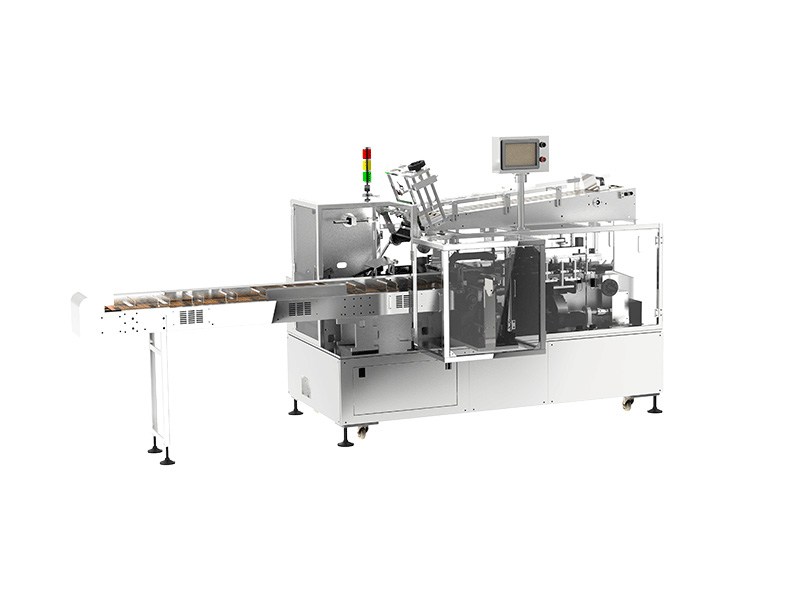
Budgeting a Clothes Folding Machine: Price Bands, Payback Windows, and the Cost per Garment
When a folding machine lands in the capital plan, the conversation usually splits in two. The purchasing side asks what the equipment costs. The operations side asks what changes on the floor, and by how much. A budget that answers only the one side question tends to get challenged by the other.
This guide covers both. It walks through what a quotation for folding equipment actually contains, where the market price bands sit, how a payback window is modelled with published wage data rather than round numbers, and — the figure that tends to decide the internal case — what the machine does to the cost of handling a single garment.

Two quotations with similar headline numbers rarely describe the same scope. Before comparing anything, break each quotation into its parts:
A supplier who itemises all six without being asked has answered a question about how the whole transaction will run.
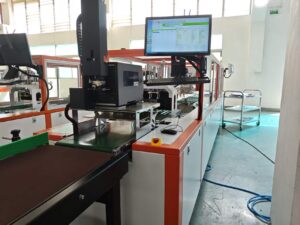
For this equipment class, typical listing ranges run as follows (excluding freight, and framed as configuration-tier references rather than quotations for a specific build):
Semi-automatic single-station folder: $2,000 to $5,000. The operator loads the garment; the machine runs the fold sequence. A fold-only unit sits toward the lower figure; adding bagging, sealing, and optional labeling moves the number upward. This tier suits operations whose daily volume has not reached full-automatic economics, or where floor space and capital budget rule out the larger line for now.
Full-automatic folding and packaging line: $20,000 to $30,000. This covers the fold-bag-seal core line in standard configuration. Four things move a specific quotation inside the band:
| Factor | Where the number sits lower | Where the number sits higher |
|---|---|---|
| Automation level | Semi-automatic single station | Full-automatic with several integrated modules |
| Functions included | Fold only | Fold + bag + seal + label + stack + vacuum |
| Garment coverage | Lightweight tees and knits | Thick-and-thin extended model for heavier garments |
| Engineering scope | Standard catalogue build | Custom fold sequence, non-standard dimensions, line integration |
| Delivery timeline | Standard machine: ships the day after contract signing | Custom build: around 3 months, including layout planning |
UBL's catalogue configurations — the single-station folding machine, the multi-functional model for mixed garment weights, and the fully automatic folding and packaging machine — map onto these tiers, and each product page lists the garment ranges and published capacities it is built for.
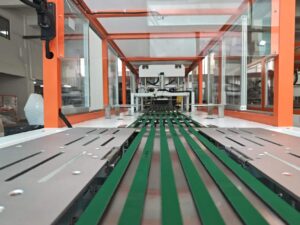
Payback arithmetic is simple: machine cost divided by monthly labour saving. The two variables that decide whether the result is credible are the wage baseline and the share of the theoretical saving that is actually captured.
Wage baseline. For a US operation, the Bureau of Labor Statistics publishes the numbers: in apparel manufacturing (NAICS 315), average hourly earnings stood at $23.53 with average weekly hours of 36.1 as of September 2026 — roughly $3,680 a month per employee. Applying a 1.3× multiplier for employer-side costs (payroll taxes, workers' compensation, benefits — an illustrative figure to be replaced with your own rate) brings the loaded cost per production position to about $4,785 a month.
For a lower-wage manufacturing market, the same model uses China's National Bureau of Statistics figure for production and related workers at enterprises above the designated size — 80,739 yuan a year in 2025, about $1,000 a month at the October 2026 exchange rate of 6.7220 yuan to the dollar, or roughly $1,300 a month loaded.
Headcount capture. A full-automatic line running about 600 pieces an hour covers the output of roughly five manual packing positions. But five positions replaced does not mean five salaries removed in month one. Some people are redeployed, overtime absorbs part of the change, attrition takes months. Model the saving at a capture rate below the theoretical figure, or the business case will not survive its first review.
| Scenario | Monthly saving, 5 positions | Payback on $20,000 | Payback on $30,000 |
|---|---|---|---|
| US wage level, full capture | about $23,900 | under 1 month | about 1.3 months |
| US wage level, 70% capture | about $16,700 | about 1.2 months | about 1.8 months |
| US wage level, 60% capture | about $14,400 | about 1.4 months | about 2.1 months |
| Lower-wage market, full capture | about $6,500 | about 3.1 months | about 4.6 months |
| Lower-wage market, 70% capture | about $4,550 | about 4.4 months | about 6.6 months |
| Lower-wage market, 60% capture | about $3,900 | about 5.1 months | about 7.7 months |
Add commissioning, training, ramp-up, and freight, and a conservative planning window for a full-automatic line comes out at roughly 2 to 8 months — nearer the lower end for US-wage operations with a high capture rate, nearer the upper end for lower-wage markets with fuller configurations.
Semi-automatic behaves differently: it does not remove a position, it raises output per person and cuts overtime. Against the $2,000–$5,000 band, with two operators gaining roughly half a position of combined capacity per shift, payback typically lands around 5 to 12 months.
Monthly savings tell a finance team something; cost per garment tells the whole business something. It converts the machine from a capital line into a unit-economics change.
Worked example, labelled as illustrative: a $25,000 full-automatic line (the midpoint of the band) amortised straight-line over five years adds about $420 a month. Running a single shift — 600 pieces an hour, 8 hours, 22 days — moves about 105,600 garments a month, so the machine itself adds well under one cent per garment. Against that, the labour saving at a US wage level with 60% capture is about $14,400 a month, or roughly 13 to 14 cents per garment. At a lower-wage market level with the same capture rate, the saving works out nearer 3 to 4 cents per garment.
Read the other direction and the comparison becomes sharper: every garment folded, bagged, and sealed by the automated line carries a fraction-of-a-cent equipment cost and no direct packing labour; the same garment through a manual station carries the full loaded labour cost of everyone who touched it. Multiply the difference by your annual volume and the case writes itself — which is also why the model is worth running with your own wage figures rather than with anyone's published ones.
UBL models this calculation during pre-sales technical review: garment mix, order structure, wage figures, and the capture rate you consider realistic for your floor.
UBL machines carry a one-year warranty covering manufacturing defects in parts and workmanship. Set against the payback windows above, the timing is deliberate: at most wage levels the machine has returned its cost before the warranty ends, and savings after that point flow as margin.
After the warranty, the running costs are mainly consumables — sealing blades, conveyor belts, suction cups, bag-opening parts — which are low-cost items available direct from the factory. Mechanical components, under normal operating conditions, generally run well past the warranty period.
Does the quoted price include installation and training? UBL's machine price includes installation, calibration, and operator training. Freight is quoted separately by destination and shipping method, and confirmed with the quotation.
Can I get a line-item quotation? Send garment type, daily volume, required output format — fold only, fold plus bagging, fold plus bagging plus labeling — and the delivery address. You will receive a formal quotation itemising base machine, add-on modules, and freight.
Are payment terms or instalments available? Terms depend on order size and customer situation. Contact the team directly to discuss workable arrangements.
What does the one-year warranty cover? Manufacturing defects in parts and workmanship for one year from delivery. Consumable wear parts are expected-replacement items outside the warranty, available at direct-from-factory prices. Warranty claims use the same support channel as operational issues, under the 6-hour remote response commitment.
Why does our quotation differ from the bands in this article? The bands describe configuration tiers for the equipment class. A specific quotation moves with the module list, garment coverage, engineering scope, freight, and payment terms. Budget with the bands; commit against a line-item quotation.
What is a realistic payback figure to present internally? Use the conservative column: count only the share of the labour saving you expect to capture, include commissioning and ramp-up, and leave throughput gains and rework reduction out of the base case. That version survives scrutiny.

 Guangdong Huanlian intelligent Packaging Group Co., LTD
 86-15915757872
 86-13602308576
 sales@huanlianauto.com
 No. 7, Silver Lake Road, Sangyuan Industrial Zone, Dongcheng District, Dongguan City
 Back to top


 86-15915757872